

How the Human Brain Learns: Psychology of Memory and the Power of Virtual Reality
The human brain is the most advanced learning system on the planet. Every day, it processes thousands of sensory inputs, filters what matters, forms associations, and stores information that seems relevant. But learning is far from accidental — it’s a structured psychological and biological process.
In recent years, virtual reality (VR) has gained attention as a powerful tool that enhances learning and memory. VR works because it transforms information into an experience — and the brain is built to remember experiences, not abstract facts.
The 3 Core Processes of Learning and Memory
1. Encoding — the brain’s decision stage
Encoding is the moment the brain decides whether information is worth storing. Strong encoding happens when learning involves:
emotion
novelty
multiple senses
personal relevance
This is why we remember our first day at a new job but not the sixth email from last Tuesday.
2. Storage — strengthening neural connections
Learning physically changes the brain. When we acquire new knowledge or skills, neurons create and strengthen connections, a process known as long-term potentiation (LTP).
The more frequently the same neural pathways are activated, the stronger and more permanent the memory becomes.
3. Retrieval — reconstructing the memory
Memory isn’t a file stored somewhere. It’s a reconstruction.
When we recall something, the brain reactivates the neural networks associated with the experience. This is why context plays a huge role — we retrieve information best in environments similar to where we learned it.

Why Virtual Reality Dramatically Improves Learning
VR enhances learning because it aligns perfectly with how the brain naturally forms and recalls memories.
1. Immersion activates multiple senses
The more senses engaged during learning, the stronger the encoding.
VR activates:
visual perception
spatial awareness
auditory input
motor responses
Studies show that multisensory learning can increase retention by 30–80%.
2. VR simulates real experiences — and the brain treats them as real
From a neurological perspective, VR triggers the same brain regions as real-life experiences.
That means learners associate information with:
emotion
environmental cues
physical interaction
These are the exact factors that deepen long-term memory.
3. Safe space for mistakes and experimentation
VR enables hands-on learning without risk:
no injuries
no damage to equipment
no social pressure
This environment supports rapid improvement, because the brain learns strongly from errors — especially when they are safe.
4. Gamification boosts dopamine and motivation
Dopamine is the neurotransmitter responsible for motivation and reward.
VR naturally supports gamified elements like:
challenges
instant feedback
progress tracking
rewards
More dopamine = more motivation = better long-term learning.
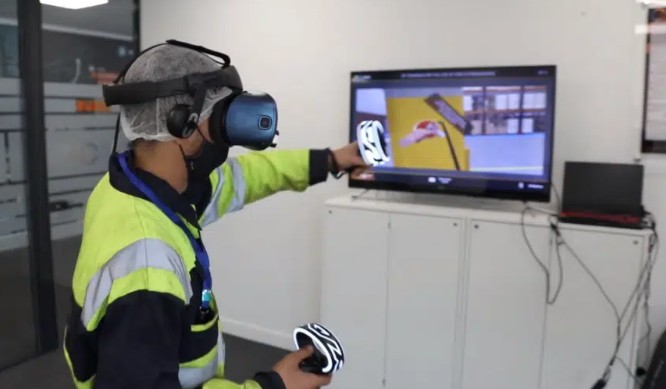
Where VR Has the Biggest Learning Impact
education and STEM learning
medical and surgical training
industrial and technical skill development
corporate training (safety, onboarding, leadership)
rehabilitation and psychological therapy
VR turns passive consumption into active engagement — and the brain remembers what we do, not just what we hear.
Conclusion
Psychology shows clearly: the brain remembers best when learning is emotional, meaningful, and experiential. Virtual reality delivers all of these elements. By turning lessons into experiences, VR becomes one of the most powerful modern tools for education, training, and professional development.